
Welcome to My Blog! I’m thrilled to have you here!
Before we dive into the content, I’d love for you to join me on my social media platforms. It’s where I share extra insights, connect with our amazing community, and keep you updated on the latest news.
Here’s how you can stay connected:
📘 Facebook: Suzhou Xize Textile Technology Co., ltd.
Now, let’s embark on this journey together! I hope you find the content here not only insightful but also inspiring and valuable. Let’s get started!
Table of Contents
Key Takeaways
- Warp knitting materials provide high strength-to-weight ratio and excellent dimensional stability
- Fiber selection (polyester, nylon, polypropylene, aramid) defines final fabric performance
- Industry standards such as ISO 13934 and ASTM D5034 guide tensile testing methods
- Warp knitting structures outperform weaving in elasticity and production efficiency
- Advanced finishing technologies significantly enhance durability and functional properties
- Automotive, medical, geotextile, and filtration industries are major application drivers
- Global demand for technical textiles is growing at ~4–6% CAGR according to industry reports
Introduction

In the modern textile industry, performance is no longer defined by appearance alone. Instead, engineering-grade functionality has become the dominant factor driving material selection. Among all textile technologies, warp knitting stands out as one of the most important structural systems used in high-performance fabric production.
Unlike traditional weaving, warp knitting builds fabrics through vertically aligned yarn systems that are looped together in a highly controlled structure. This creates materials that are not only lightweight but also exceptionally stable under mechanical stress.
According to global technical textile white papers published by organizations such as Techtextil and the Textile Institute, demand for warp-knitted structures in industrial applications has increased steadily over the past decade, particularly in automotive safety systems, geotextiles, and medical reinforcement fabrics. This growth is largely driven by the need for materials that combine flexibility, durability, and cost efficiency.
Understanding warp knitting materials in depth is essential for manufacturers, engineers, and procurement specialists seeking to optimize product performance in highly demanding environments.
Warp Knitting Materials Science and Structural Engineering Principles
Molecular and Fiber-Level Behavior in Warp Knitting
At the fiber level, warp knitting materials rely on synthetic polymers such as polyester, nylon, and polypropylene. These fibers exhibit semi-crystalline structures that influence tensile strength, elasticity, and thermal stability.
Polyester, for example, has a melting point of approximately 255°C and maintains excellent dimensional stability under mechanical load. Nylon, on the other hand, exhibits higher elasticity due to its hydrogen bonding structure, allowing it to absorb impact energy effectively.
These molecular differences directly impact how warp knitted fabrics behave under stress.
Structural Mechanics of Warp Knitting Systems
Warp knitting uses a loop-based interlocking structure where each yarn runs longitudinally through the fabric. This structure provides:
- High resistance to deformation under load
- Controlled stretch behavior in multiple directions
- Reduced risk of yarn slippage under repeated stress
From a mechanical engineering perspective, warp knitted fabrics distribute force more evenly than woven structures, reducing localized stress concentrations that often lead to early failure.
High-Performance Warp Knitting Materials Classification System
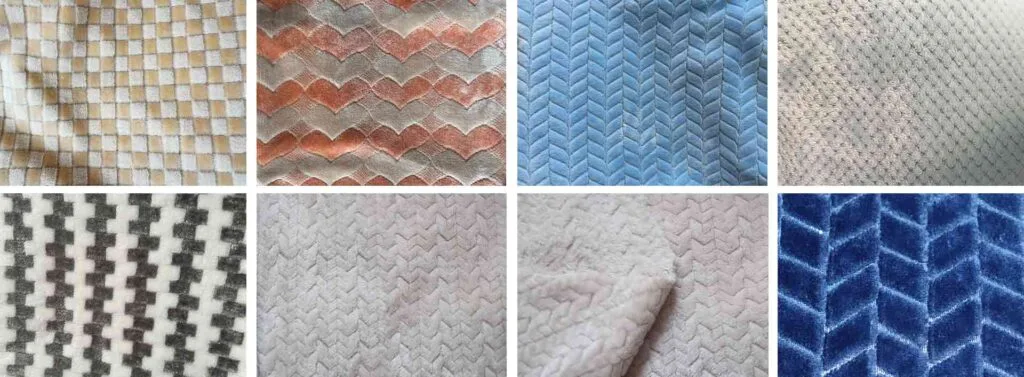
Polyester-Based Industrial Warp Knitting Materials
Polyester remains the dominant fiber in industrial warp knitting applications due to its balance of cost, durability, and performance.
Mechanical properties (typical industrial grade PET)
- Tensile strength: 6–9 g/denier
- Elongation at break: 15–30%
- Density: 1.38 g/cm³
Industrial advantages
Polyester exhibits excellent resistance to UV degradation and moisture absorption below 0.5%, making it highly suitable for outdoor and automotive applications.
Major application sectors
- Automotive seat reinforcement fabrics
- Conveyor belt reinforcement layers
- Geotextile stabilization grids
Nylon Warp Knitting Materials for Dynamic Load Systems
Nylon (Polyamide 6 and Polyamide 66) is widely used where elasticity and energy absorption are critical.
Mechanical characteristics
- Tensile strength: 7–10 g/denier
- High impact resistance
- Moisture absorption: 3–8% (affects flexibility)
Engineering concept
Nylon’s ability to deform and recover makes it ideal for applications involving repeated mechanical loading cycles.
Applications
- Sports protection textiles
- Industrial safety nets
- Elastic reinforcement structures
Polypropylene Warp Knitting Materials for Chemical Resistance
Polypropylene is valued for its lightweight structure and chemical resistance.
Key properties
- Density: 0.91 g/cm³ (lowest among major fibers)
- Excellent acid and alkali resistance
- Low moisture absorption
Industrial usage
- Filtration membranes
- Agricultural covering systems
- Packaging reinforcement fabrics
Aramid and High-Performance Composite Warp Knitting Materials
Aramid fibers (such as Kevlar-type materials) represent the highest-performance category.
Mechanical performance
- Tensile strength: 20–25 g/denier
- Thermal resistance: up to 400°C (decomposition range)
- Exceptional cut resistance
Application environments
- Aerospace reinforcement textiles
- Ballistic protection systems
- High-temperature industrial shielding
Warp Knitting vs Weaving: Engineering-Level Performance Comparison
Structural Load Distribution Differences
Weaving creates interlaced yarn intersections, while warp knitting uses looped interconnections.
This leads to fundamental performance differences:
| Performance Factor | Warp Knitting | Weaving |
|---|---|---|
| Elasticity | High | Low |
| Dimensional Stability | High | Medium |
| Production Speed | High | Medium |
| Tear Resistance | High | Medium |
| Cost Efficiency | High (mass production) | Medium |
Energy Absorption Behavior
Warp knitted fabrics absorb mechanical energy more evenly across the structure. This reduces the likelihood of catastrophic failure under sudden impact loads, making them suitable for automotive safety systems.
International Testing Standards for Warp Knitting Materials
ISO 13934-1: Tensile Strength Testing
Defines the method for measuring fabric breaking force using strip testing.
ASTM D5034: Grab Test Method
Widely used in the United States for evaluating fabric tensile strength.
ISO 12947: Martindale Abrasion Testing
Used to measure wear resistance under repeated friction cycles.
Industry Benchmark Data
- Automotive textiles: minimum 30,000 abrasion cycles
- Industrial geotextiles: over 100,000 cycles required in heavy-duty applications
Warp Knitting Manufacturing Technology Deep Dive
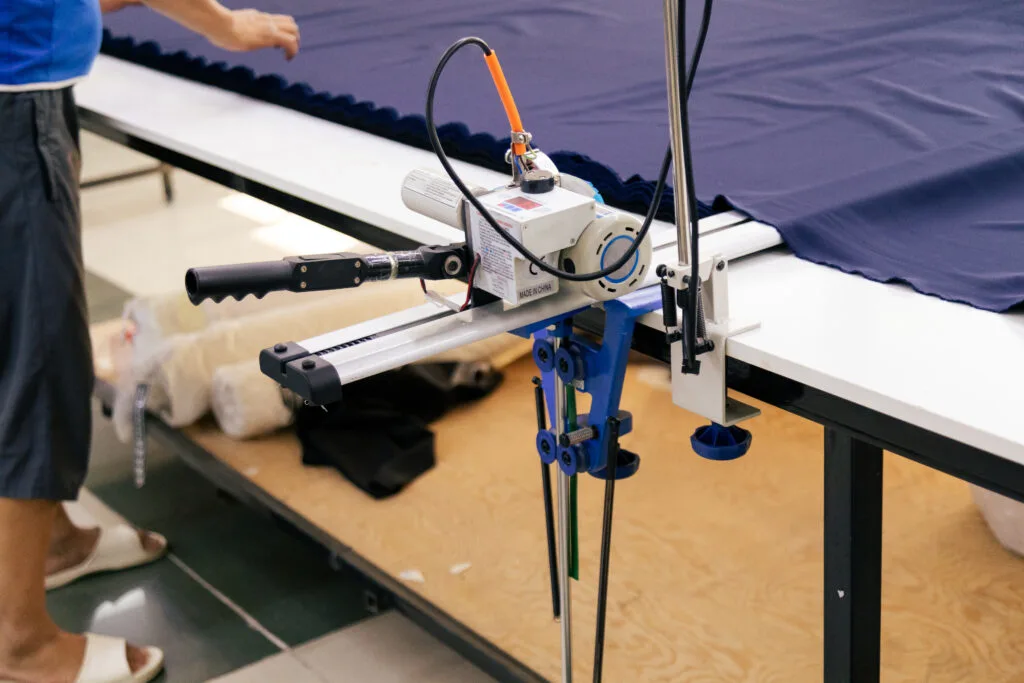
Warp Beam Preparation Technology
Yarn tension must be controlled within ±2–5% variation to ensure uniform fabric structure.
Improper tension control leads to:
- Uneven loop formation
- Reduced tensile strength
- Structural distortion
High-Speed Warp Knitting Machine Systems
Modern warp knitting machines operate at speeds exceeding 2,000–3,000 rpm depending on configuration.
Key technological improvements include:
- Electronic guide bar control
- Computerized pattern programming
- Real-time tension monitoring systems
Finishing and Functional Enhancement Processes
Post-processing significantly enhances fabric performance:
Heat setting
Stabilizes molecular orientation and reduces shrinkage.
Coating systems
Add water resistance, flame retardancy, or UV protection.
Lamination
Combines multiple fabric layers for composite performance enhancement.
Industrial Application Fields of Warp Knitting Materials
Automotive Industry Applications
Warp knitted fabrics are widely used in:
- Seat covers
- Airbag reinforcement layers
- Door panel structures
According to automotive material reports, over 60% of modern vehicle interior textiles include warp-knitted components.
Medical Textile Engineering
Warp knitting supports advanced medical applications such as:
- Surgical meshes
- Compression therapy textiles
- Wound healing fabrics
These materials must meet strict biocompatibility standards such as ISO 10993.
Geotextile Engineering and Civil Construction
Warp knitted geotextiles are used in:
- Soil stabilization systems
- Roadbed reinforcement
- Erosion control layers
Field studies show that reinforced soil systems using warp-knitted geotextiles can increase load-bearing capacity by up to 40%.
Filtration and Industrial Separation Systems
Warp knitting improves filtration efficiency through controlled porosity structures.
Applications include:
- Liquid filtration membranes
- Air purification systems
- Chemical processing filters
Warp Knitting Materials Performance Optimization Factors
Loop Density Engineering
Higher loop density increases strength but reduces flexibility. Optimization depends on application requirements.
Yarn Denier Selection Strategy
Typical industrial range:
- Lightweight fabrics: 50–150 denier
- Heavy-duty reinforcement: 300–1000 denier
Surface Treatment Technology Impact
Surface finishing can improve:
- Abrasion resistance by 20–50%
- UV resistance by up to 3×
- Water repellency significantly
Industry Case Study: Automotive Warp Knitting Fabric Optimization
Project Overview
A European automotive supplier upgraded seat reinforcement materials using high-performance polyester warp knitting fabrics.
Technical challenge
- Material deformation under long-term load
- High humidity performance degradation
Solution
- High-density polyester warp knitted structure
- Heat-set finishing process
- UV-stabilized coating layer
Results
- 22% improvement in dimensional stability
- 18% increase in abrasion resistance
- Extended service life by approximately 2.5 years
Market Trends and Industry White Paper Insights
Global Technical Textile Growth
Industry reports from Grand View Research and Statista indicate:
- Technical textiles market expected to exceed USD 250+ billion by 2030
- Warp knitting segment growing at 4–6% CAGR
- Automotive and medical sectors are primary growth drivers
Sustainability Trends
Modern warp knitting production is shifting toward:
- Recycled polyester fibers (rPET)
- Waterless dyeing technologies
- Energy-efficient knitting systems
Common Failure Modes in Warp Knitting Materials
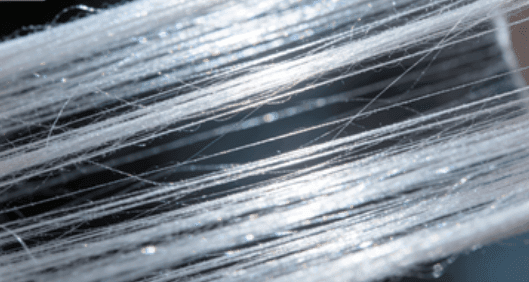
Yarn Slippage Failure
Occurs when loop tension is insufficient.
Abrasion Degradation
Common in industrial environments with continuous friction.
UV Degradation
Polymer chain breakdown due to long-term sunlight exposure.
Conclusion
The evolution of warp knitting technology continues to redefine modern textile engineering. With advancements in fiber science, digital manufacturing, and functional finishing technologies, warp knitted materials now deliver exceptional performance across multiple industrial sectors.
As global demand shifts toward lightweight, high-strength, and multifunctional materials, warp knitting will remain a foundational technology in technical textiles. Its ability to combine mechanical strength, design flexibility, and production efficiency ensures its continued dominance in automotive, medical, and industrial applications for years to come.
FAQ
What makes warp knitting materials high performance?
Their looped structure provides superior dimensional stability, strength distribution, and controlled elasticity.
Which fiber is best for warp knitting applications?
Polyester is the most widely used due to its balance of strength, cost, and durability.
Is warp knitting better than weaving for industrial use?
In many industrial applications, yes—especially where elasticity, speed, and cost efficiency are important.
Can warp knitting materials be customized?
Yes, customization includes fiber type, density, finishing treatments, and functional coatings.
What industries use warp knitting materials most?
Automotive, medical, geotextile, filtration, and protective textile industries.